

Children’s room decoration isn’t just about choosing pretty pieces. The key is to create a balanced set where walls, colors, textiles, pictures, and small details follow the same visual line.
In this guide, you’ll see how to decorate a children’s room with good judgment: from choosing the style and color palette to how to combine vinilos infantiles, papel pintado infantil, murales, cuadros, placas, textiles, and posters without the result looking like a mix of loose pieces.
What it means to create a coherent children’s room decoration
A coherent children’s room decoration is one where all the elements seem to be part of the same idea. It doesn’t mean everything has to be the same, nor that each piece must repeat the same color or design. It means there is a clear visual relationship between what happens on the wall, the bed, the textiles, the pictures, and the decorative details.
When a children’s room is coherent, the space feels more cared for. The feature wall doesn’t compete with the textiles. The pictures don’t seem randomly added. The colors are repeated intentionally. Small details, like a door plaque or a poster, complement the whole without breaking it.
That’s why, before buying children’s decoration, it’s best to think of the room as a complete scene. The question shouldn’t just be “Do I like this product?” but “Does it fit with the atmosphere I want to create?”

Before decorating: define the room’s style
Before decorating a children’s room, it’s best to define a general aesthetic idea. This step avoids one of the most common situations: choosing pretty pieces separately that, when put together, don’t quite work.
There’s no need to create a complex project. Just decide what feeling you want the room to convey. It could be a sweet and relaxing room, an adventurous space, a natural room, a fantasy bedroom, a room with animals, a space-inspired room, a floral, maritime, Nordic, or minimalist atmosphere.
This initial decision helps better filter every subsequent choice. For example, if you want a children’s room with a natural style, soft tones, forest motifs, delicate animals, or plant details will probably work better. If you prefer an adventurous room, maps, balloons, ships, planets, or compositions with more visual movement might make more sense.
Defining the style doesn’t limit creativity. On the contrary, it helps each choice have a clear direction.
Choose a color palette to avoid overwhelming the room
A well-thought-out color palette helps the children's room look more balanced. It’s not necessary to follow strict rules, but it’s a good idea to choose two or three main tones and repeat them in different parts of the space.
You can start with a soft base tone for walls or textiles, add a second color that reinforces the theme, and reserve a third tone for small accents. This way of working allows the room to have personality without looking overloaded.
For example, a room with beige tones, soft green, and wood visuals can convey calm and naturalness. A combination of blue, off-white, and gray details can fit a maritime or space-themed room. A palette with dusty pink, sand, and floral touches can work in a sweet room without going overboard.
Color theory applied to interior design helps understand how tones interact with each other and how they can create visual harmony within a space. You can consult this color theory guide applied to interior design as an external reference to delve deeper into this point.

Decide which will be the main wall
Not all walls in a child's room should have the same visual weight. Choosing a main wall helps organize the decoration and prevents the room from looking cluttered.
The main wall can be the headboard wall, the play area, the reading corner, the wall visible upon entering, or the crib or bed area. The important thing is that it makes sense within the actual use of the room.
If you choose a main wall, you can reserve the element with the most presence there: a children's mural, wallpaper, a composition of pictures, or a larger vinyl decal. The rest of the walls can remain cleaner or be accompanied by more discreet details.
This balance is important because a child's room needs areas with visual interest, but also quiet spaces where the eye can rest.
7 keys to transform a child's room with design
Transforming a child's room with design doesn't require filling every corner. It requires choosing well the role each element plays within the whole.
1. Use children's wall decals to add personality without overloading
Children's wall decals are a very useful decorative resource to add character, theme, or small visual details to a child's room.
They can be used to reinforce a specific wall, accompany a bed or crib area, create a light composition, or introduce a decorative motif without visually occupying the entire room. They work especially well when you want to add personality without turning the whole wall into the absolute focal point of the room.
To integrate them coherently, it’s best if the colors or theme of the vinyl connect with the rest of the space. If the room already has textiles in blue, green, or pink tones, you can look for a vinyl that dialogues with that same color range.
2. Choose children’s wallpaper to give visual continuity
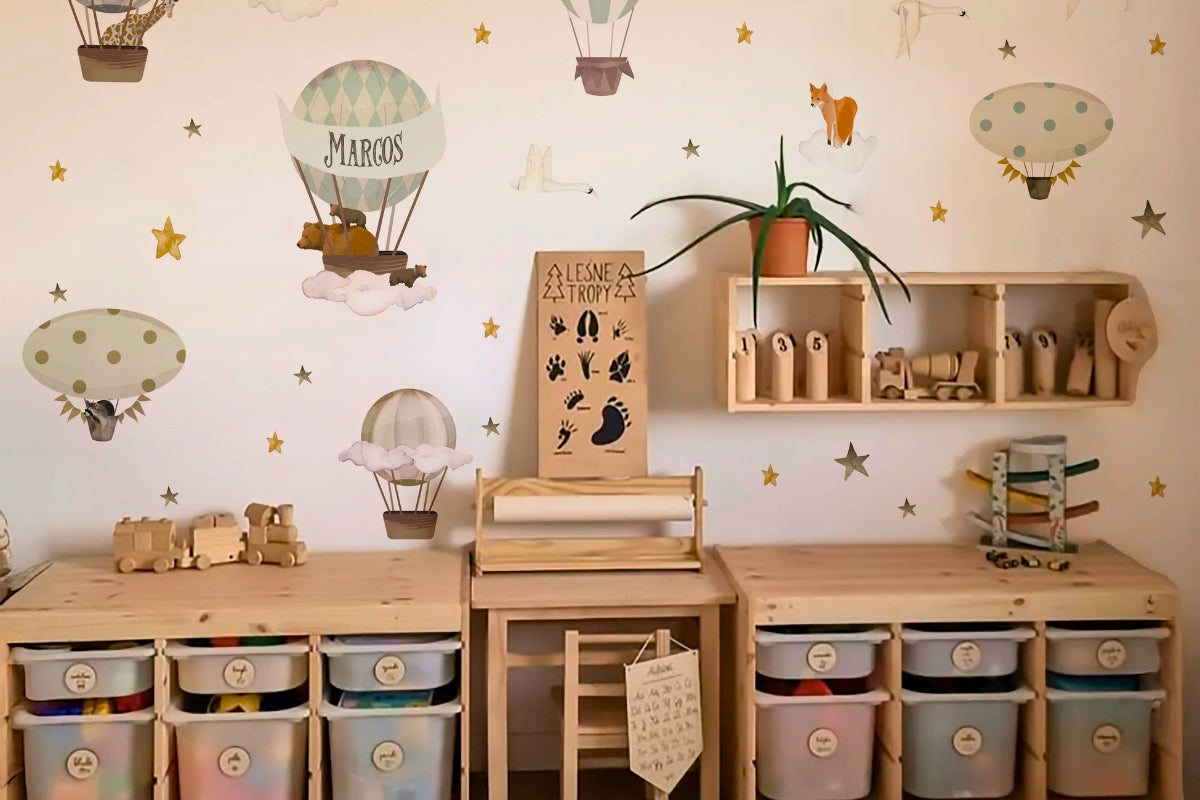
Children’s wallpaper helps create a more immersive decorative base. It’s an interesting option when you want the wall to set the overall style of the room.
Unlike a single detail, wallpaper has a more continuous presence. It can wrap the headboard wall, reinforce a play area, or create a fuller feeling in the bedroom.
For it to work, the rest of the elements should complement, not compete. If the wallpaper has visible motifs, the pictures, textiles, and posters can be more subdued. If the design is softer, it better allows for small decorative details around it.

3. Opt for children’s murals if you want a standout wall
Children’s murals are suitable when you want a wall to play a central role in the room. They are especially interesting for creating visual impact and defining a clear theme.
A mural can turn the headboard wall, the bed area, or a special corner into the most recognizable point of the room. That’s why it’s best to choose it at the beginning of the decorating process, not at the end.
If the mural is very prominent, the rest of the decoration should act as accompaniment. More coordinated textiles, well-chosen pictures, and small details in the same color range can help the whole look intentional.
4. Complete the composition with children’s pictures
Personalized children’s pictures help visually close off a wall, reinforce a theme, or add a more personal touch within the room.
They can be placed on a dresser, next to the bed, on a secondary wall, or arranged as a small composition. The key is not to use them as isolated pieces unrelated to the rest of the room.
If the room has a theme of animals, space, flowers, maps, or fantasy, the pictures can reinforce that visual story. They can also provide balance when the main wall doesn’t need a full mural but does need a decorative focal point with intention.

5. Add children’s plaques to personalize the door or a corner
Children’s door plaques add a personal touch without dominating the whole room. They work well on the door but can also be integrated into a specific corner if they fit the overall style.
This type of detail helps personalize the space subtly. It doesn’t need to compete with the main wall or become the focal point. Its role is to add identity and a sense of belonging.
To maintain coherence, the plaque should relate to the theme or colors chosen for the room.
6. Coordinate children’s textiles with the wall
Children’s textiles are one of the most important pieces to unite wall decor with the rest of the room.
Covers, cushions, curtains, or other textile elements can repeat colors found in a mural, wallpaper, vinyl, or a composition of pictures. This visual repetition makes the room feel more connected.
A common mistake is decorating the wall heavily while leaving textiles completely disconnected. When that happens, the room can feel divided into parts. Instead, if textiles act as a bridge between the wall and furniture, the result is more harmonious.
7. Use children’s posters to refresh without changing the whole room
Children’s posters can help update a specific area or complete a decorative composition without changing the entire room.
They are useful for giving a fresh look to a corner, reinforcing a theme, or adding a visual detail on a secondary wall. They also allow for lighter changes when the room’s base is already defined.
To avoid them seeming like unintentional additions, it’s best to choose posters that share color, style, or theme with the rest of the children's decor.
How to combine walls, textiles, and details without it looking like a mix of loose pieces
For a children's room to look coherent, each element must relate to the others. It’s not necessary for everything to belong to the same collection, but there should be a common thread.
Some practical recommendations:
- Repeat one or two key colors on walls, textiles, and details.
- Maintain a main theme and avoid mixing too many visual stories.
- Do not combine very different decorative styles unless there is an element that unites them.
- Leave some areas visually cleaner.
- Use textiles as a bridge between the wall and decorative objects.
- Review the room as a whole, not product by product.
- Before adding something new, think if it adds balance or just takes up space.
A good way to check is to look at the room from the entrance. If your eye quickly understands the focal point, which colors repeat, and what atmosphere the room conveys, the composition is on the right track.

Which option to choose based on the result you want
Each decorative product serves a different function. Choosing well depends on the type of change you want to achieve.
| Decorative goal | Recommended product | When to choose it |
|---|---|---|
| Quick visual change | Children’s vinyls | When you want to add personality, theme, or details without transforming the entire room. |
| More immersive room | Children’s wallpaper | When you’re looking for a continuous decorative base that defines the room’s style. |
| Feature wall | Children’s mural | When you want a wall to have the greatest visual weight in the room. |
| Emotional personalization | Personalized pictures or birth announcement pictures for babies | When you want to add a memory, a name, an initial, or a more personal detail. |
| Welcome detail | Children’s plaques | When you want to personalize the door or a corner without overloading the whole. |
| Complete coherence | Coordinated children's textiles | When you need to connect the wall with the bed, crib, or the rest of the space. |
| Simple refresh | Children’s posters | When you want to update a specific area without changing the base decor. |
Common mistakes when decorating a children's room
The most common mistakes happen when decorating impulsively, without a common idea. These are the ones that most affect the final result:
- Buying individual pieces without a shared visual line.
- Decorating all walls with the same intensity.
- Mixing too many colors without hierarchy.
- Choosing a mural or wallpaper without considering textiles, pictures, and details.
- Forgetting the role of textiles within the overall design.
- Not leaving visually calm spaces.
- Copying inspiration without adapting it to the actual size, light, or layout of the room.
- Thinking only about the wall and not the entire room.
- Over-personalizing to the point where all elements compete with each other.
The solution is not to decorate less, but to decorate with more intention. Each piece should serve a purpose: to stand out, complement, connect colors, reinforce a theme, or add personalization.
How to create a personalized children's room without losing coherence
Personalizing a child's room doesn’t mean filling it with names, colors, or standout elements. Personalization can be subtle and still special.
You can personalize with a placa on the door, a birth picture, a mural with a specific theme, a vinyl that reflects a hobby, or a well-integrated composition of pictures. The important thing is to decide which element will be the emotional focus and let the rest accompany it.
For example, if you choose a birth picture as the most sentimental piece, you can place it on a secondary wall or combine it with other more neutral pictures. If the name appears on a placa, it might not be necessary to repeat it in too many places in the room.
Personalization works best when it adds identity without breaking visual harmony.
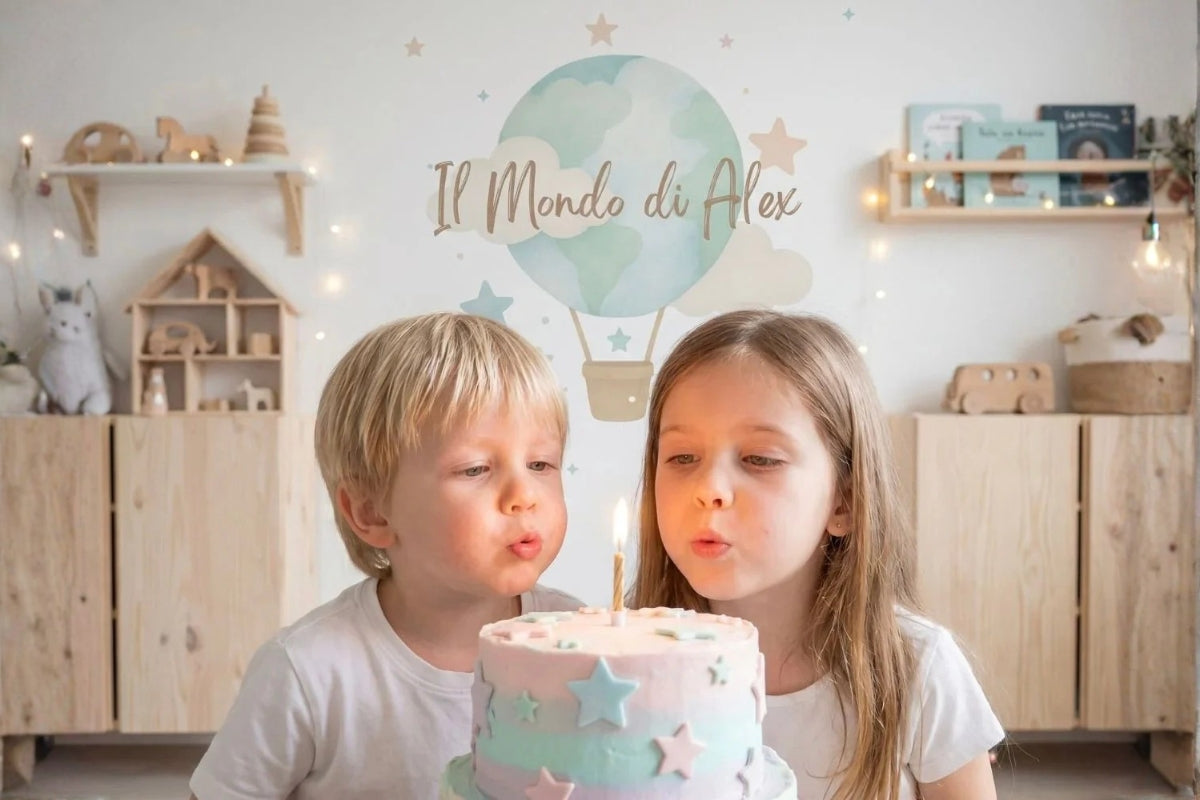
How Il Mondo di Alex can help you create a meaningful child's room
Il Mondo di Alex brings together different categories of decoración infantil that allow you to create children's rooms with a consistent visual line: vinilos, papel pintado infantil, murales, cuadros, textiles, placas, and alfombras vinílicas.
This makes it easier to think of the room as a whole. You can start with a feature wall, add textiles that connect with the color palette, complete an area with children's pictures, and finish the space with small personalized details.
If you're looking for inspiration to refresh the room without losing coherence, you can also check the decoración infantil en oferta y outlet category as a secondary starting point to find pieces that fit the style you’ve already defined.
The key is to choose with intention: first the atmosphere, then the colors, and finally the pieces that will shape the whole.
FAQs about decorating a child's room
How to start decorating a child's room?
Start by defining the overall style of the room. Before choosing specific products, decide what atmosphere you want to create: sweet, natural, adventurous, floral, space-themed, maritime, or minimalist. Then choose a color palette and a feature wall. This way, each vinyl, mural, picture, textile, or decorative detail will have a clear role within the whole.
What is the most important thing in decorating a child's room?
The most important thing in decorating a child's room is visual coherence. It's not about filling the room with pretty elements, but about making sure the wall, colors, textiles, pictures, and decorative details relate to each other. A coherent room feels more cared for, balanced, and pleasant.
Which wall should be highlighted in a child's room?
It's best to highlight the wall that makes the most visual and functional sense. It can be the headboard wall, the crib or bed area, the reading corner, the play area, or the wall seen upon entering. The important thing is that this wall concentrates the greatest decorative weight and the rest of the space supports it.
Which is better: children's vinyl, wallpaper, or mural?
It depends on the result you want. Children's vinyl is useful for adding personality or visual details. Children's wallpaper works well to create continuity and a more immersive decorative base. The children's mural is recommended when you want a wall to play a leading role in the room.
How to combine colors in a child's room?
Choose two or three main tones and repeat them in different parts of the room. You can use a soft base color, a second tone that reinforces the theme, and small color accents in textiles, pictures, or posters. Avoid mixing too many colors with the same intensity to prevent visually saturating the space.
How to decorate a child's room without overloading it?
To decorate without overloading, define a main wall and leave other areas cleaner. Maintain a main theme, use a limited color palette, and choose pieces that serve a specific function. Not all elements should stand out; some should accompany and balance the whole.
How to make a child's room look more coherent?
To make a child's room look more coherent, repeat colors, connect the wall theme with the textiles, and avoid mixing very different styles. It also helps to review the room from the entrance and check if all the elements seem to be part of the same decorative idea.
What decorative elements help personalize a child's room?
Personalized pictures, birth plaques, children's door signs, vinyls, murals, and posters can help personalize a child's room. The key is to choose one or two elements with more personal significance and combine them with more neutral pieces to maintain visual balance.
How to combine children's textiles with wall decoration?
Children's textiles should act as a bridge between the wall and the rest of the room. You can repeat some of the colors present in the mural, wallpaper, vinyl, or pictures in the bedding, cushions, or curtains. This way, the decoration is not separated by zones but connected.
What mistakes should you avoid when decorating a child's room?
Avoid buying loose pieces without a common idea, decorating all the walls with the same intensity, mixing too many colors, choosing a mural without considering the textiles, and copying inspiration without adapting it to the actual space. It's also good to leave visually calm areas so the room can breathe.

Leave a comment
All comments are moderated before being published.
This site is protected by hCaptcha and the hCaptcha Privacy Policy and Terms of Service apply.