
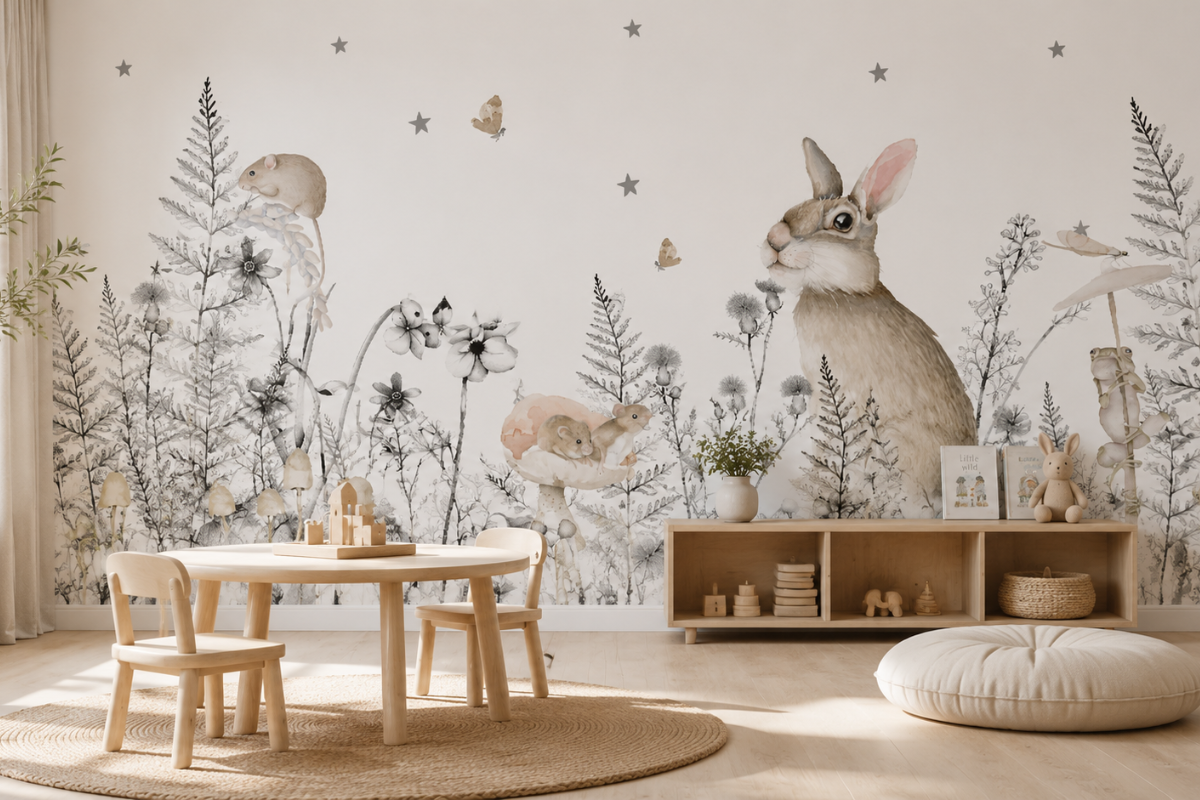
Children’s decoration for professional spaces is not just about adding drawings, colours or characters to a wall. In nurseries, early years schools, paediatric hospitals, clinics, family hotels, playrooms or children’s leisure areas, decoration forms part of the experience of the space.
A well-planned children’s environment can make a room feel warmer, more considered and more coherent. It also helps to differentiate areas, reinforce the visual identity of the place and create a sense of welcome for both children and families.
The key is to design with intention. It is not about decorating every corner, but about choosing which areas need prominence, which elements should support the overall look and how to combine resources such as children’s wall stickers, children’s wall murals, children’s wallpapers, children’s wall art, textiles, decorative plaques, height charts or children’s rugs without overwhelming the atmosphere.

Why children’s decoration also matters in professional spaces
When a family enters a nursery, a paediatric consultation room or a family hotel, the space communicates before any explanation is given. Decoration conveys care, order, sensitivity and coherence.
In professional spaces designed for children, decoration can fulfil several functions:
- Make the environment feel less cold or impersonal.
- Help differentiate areas: play, rest, reading, waiting, reception or circulation.
- Create a recognisable visual identity for the centre, clinic, hotel or playroom.
- Support the family experience, especially during waiting or adaptation moments.
- Turn an empty wall into a useful visual resource without having to renovate the entire space.
The important point is that decoration should serve the use of the space. A nursery classroom does not need the same approach as a paediatric waiting room. A hotel kids club is not designed in the same way as a family bedroom. That is why it is always best to start with the function of each area before choosing colours, themes or products.
Children’s decoration for nurseries and early years schools
In nurseries and early years schools, decoration should help create recognisable, pleasant and well-organised spaces. These are environments with heavy daily use, many stimuli and different moments: free play, guided activities, rest, reading, lunch, arrival and departure.
Here, visual coherence is especially important. If each classroom has a different theme, too many colours or disconnected decorative elements, the result can feel disorganised. On the other hand, when a shared visual line is defined, the whole centre gains a stronger sense of unity.
A good way to approach it is to work by areas:
- Main classrooms: walls with a soft visual base and one feature point.
- Play areas: more dynamic elements, with stickers, illustrations or murals that add energy.
- Reading corners: calmer designs, with soft tones and less crowded compositions.
- Rest areas: cleaner decoration, with less visual stimulation.
- Corridors and entrances: decorative resources that help identify classrooms, age groups or routes.
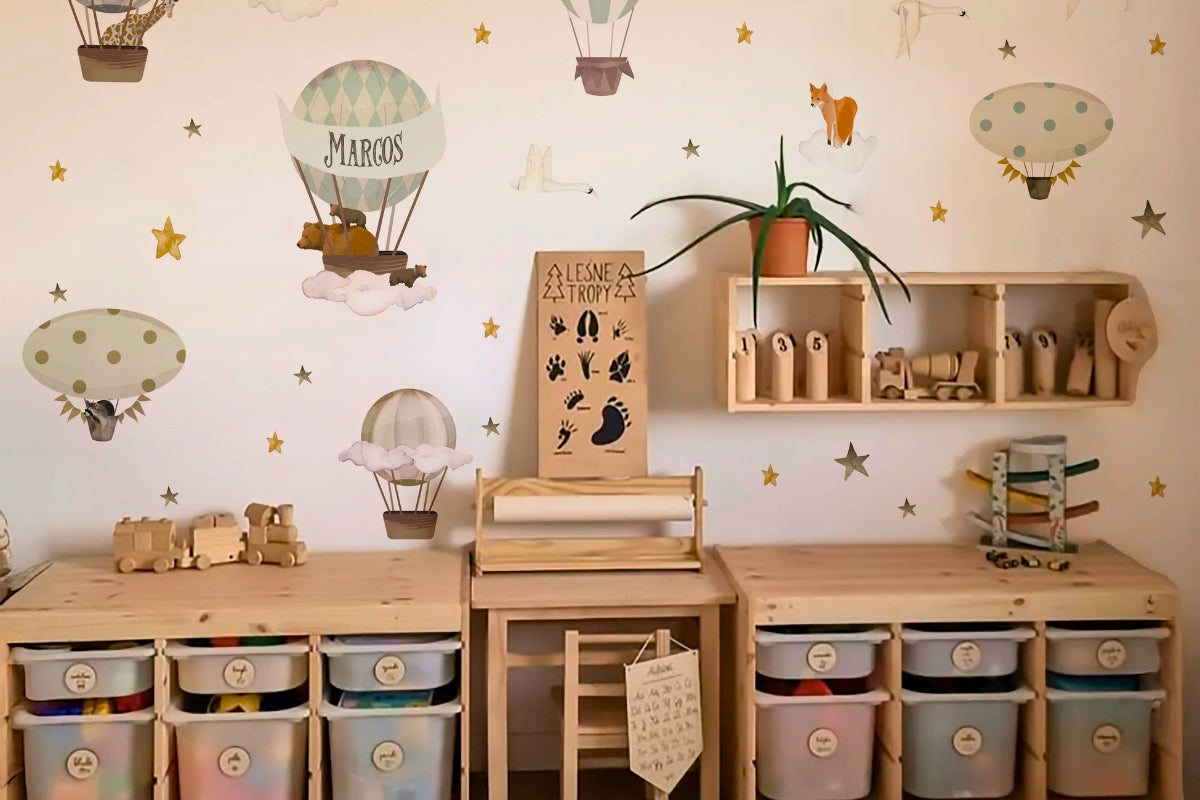
Children’s wall stickers can work well in specific areas, such as a welcome wall, a reading corner or a play area. Children’s wall murals can be reserved for more prominent spaces, such as an entrance, a main classroom or a shared room.

Ideas for decorating a nursery with coherence
For nursery decoration to work, it is best to avoid an accumulation of styles. It is preferable to choose a clear visual line and repeat it with small variations.
For example, an early years school can work with a nature theme using animals, trees, flowers or green and beige tones. Another can choose maps, clouds, stars or hot air balloons if it is looking for a lighter, travel-inspired aesthetic. The important thing is not to choose a “beautiful” theme, but one that can be applied across different areas without losing order.
Some practical ideas:
- Choose one main colour palette and use it in classrooms, textiles and decorative details.
- Reserve the most visible walls for feature elements, such as a mural or an XXL wall sticker.
- Use children’s wall art to complete smaller areas without overloading them.
- Add decorative plaques or wooden names to identify classrooms, corners or spaces.
- Use children’s height charts in classrooms or corridors where they fit naturally.
- Keep rest areas with fewer visual elements than play areas.
The goal is not for everything to look the same, but for everything to feel part of one single project.
Decoration for children’s hospitals, clinics and paediatric consultation rooms
In children’s hospitals, clinics and paediatric consultation rooms, decoration requires particular care. These are spaces where it is helpful to create a warmer atmosphere without making promises that decoration itself cannot fulfil.
A more approachable visual environment can help the experience feel less cold, especially in waiting rooms, corridors, reception areas or children’s consultation rooms. But it must be handled with balance: too many stimuli, intense colours or overly invasive children’s elements can create the opposite effect.
In these spaces, clean compositions, soft tones and recognisable but not overly busy themes usually work well. Nature, animals, sky, clouds, stars, rainbows or landscape scenes can bring a friendly visual language without making the space feel chaotic.
Children’s wallpapers can bring visual continuity to a specific wall, while wall stickers allow you to work on specific areas without decorating the entire room. Children’s wall art can also help complete waiting rooms, corridors or consultation rooms with a lighter solution.

How to decorate a paediatric consultation room without overloading the space
A paediatric consultation room should remain functional, clear and easy to read visually. Decoration should not compete with the main activity of the space.
An effective way to approach it is to choose one single feature point. This could be the wall behind an examination area, a side wall in the waiting room or an area visible from the entrance. From there, the rest of the elements should support it.
Useful criteria:
- Avoid mixing too many themes in the same room.
- Prioritise soft or balanced tones over very intense colours.
- Use wall stickers or pictures in specific areas, not on every wall.
- Keep areas that need maximum visual clarity free of decoration.
- Choose designs that can coexist well with clinical furniture, signage and functional elements.
For example, a waiting room can work with a soft mural of animals, clouds or a landscape on one wall, and complete the rest with coordinated pictures. A small consultation room, on the other hand, may work better with a medium-sized wall sticker and a few discreet visual details.
Children’s decoration for family hotels and tourist spaces
In family hotels, tourist accommodation and family-friendly spaces, children’s decoration fulfils a different function: it helps improve the stay experience and reinforces the perception that the space has also been designed with children in mind.
This does not only apply to bedrooms. Common areas, kids clubs, play spaces, waiting areas, family corridors or children’s corners inside restaurants and receptions can also be decorated.
In hotels, decoration should integrate with the overall identity of the establishment. It is not advisable to create an excessive contrast between a carefully designed adult aesthetic and an improvised children’s area. Ideally, the children’s space should have its own personality while maintaining coherence with the hotel’s visual tone.
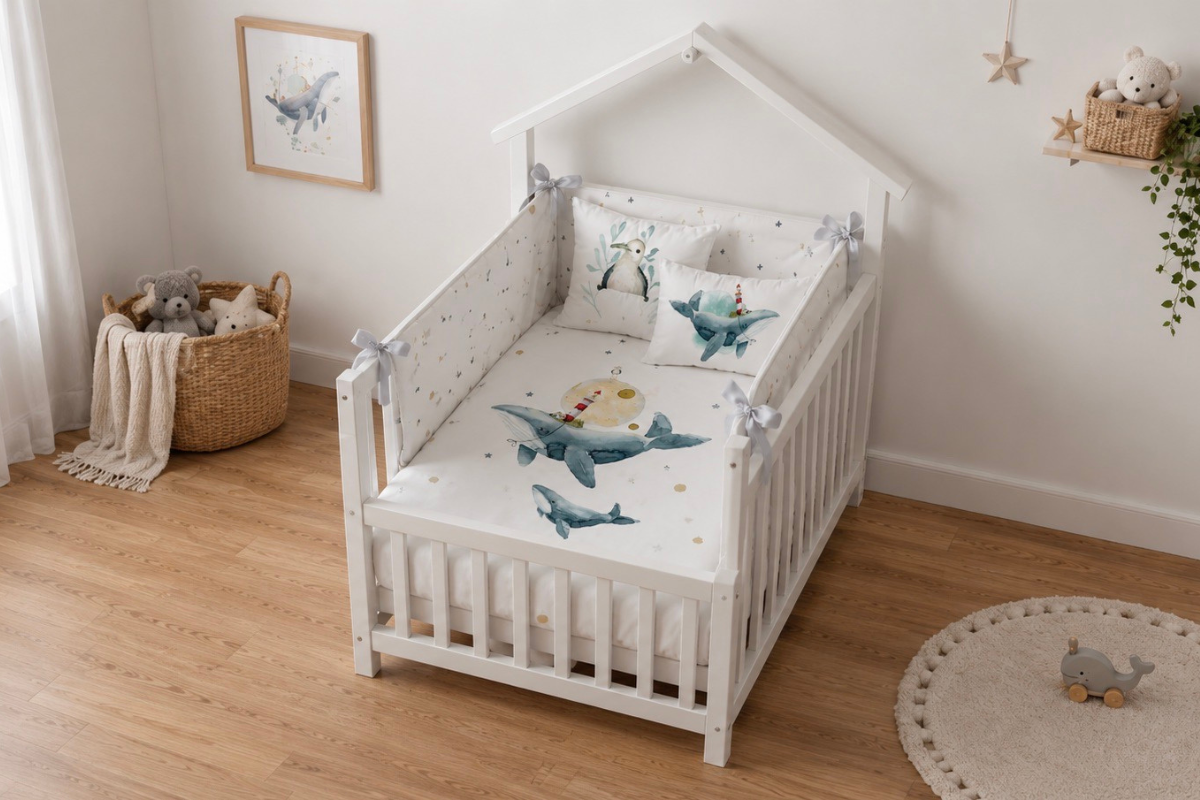
Custom children’s wall murals can be especially useful in high-impact areas, such as kids clubs, family bedrooms or play walls. Children’s textiles, such as duvet covers or cushions, can reinforce the theme in family rooms without changing the entire architecture of the space. Children’s rugs can also help define play or rest areas within a common space.

Which decorative elements work well in family-friendly hotels
In family hotels, visually attractive but controlled decoration usually works best. The space should appeal to children while also fitting the quality perception expected by adults.
Elements that can work well:
- Panoramic murals for family rooms, kids clubs or play areas.
- Large children’s wall stickers to create visual points without filling every wall.
- Coordinated textiles in family bedrooms or rest areas.
- Children’s wall art to complete secondary walls.
- Children’s rugs to define play areas in shared spaces.
- Decorative plaques to identify rooms, children’s areas or themed corners.
In hotels, it is especially important not to over-childish the whole space. Good family-friendly decoration does not have to look like a theme park. It can be elegant, warm and memorable without losing balance.
Which decorative elements can fit into professional children’s spaces
Each decorative product has a different function within the project. The key is to combine them according to the use of the area and the level of prominence you want to give it.
Children’s wall stickers are useful for working on specific walls, creating visual scenes, decorating corners or adding personality without transforming the entire room. They work well in classrooms, waiting rooms, play areas, corridors or family bedrooms.
Children’s wall murals have greater visual presence. They are suitable for feature walls, entrances, kids clubs, main classrooms or rooms where a more immersive image is desired.
Children’s wallpaper allows you to create visual continuity and texture. It can work well in areas where a more integrated decoration is needed, especially if a soft pattern or a theme that does not become tiring is chosen.
Children’s wall art allows you to complete the decoration flexibly. It is useful for corridors, receptions, waiting rooms, reading corners or secondary walls.
Children’s textiles, such as duvet covers, cushions or curtains, help reinforce the coherence of a bedroom or rest area. In family hotels or early years schools, they can provide visual continuity without relying only on the wall.
Room plaques or wooden names can be used to identify spaces, classrooms, corners or rooms, adding a more personalised detail.
Children’s height charts can fit into nurseries, classrooms or play spaces where they make sense within the experience of the space.
Children’s rugs can help create more defined areas, especially in playrooms, kids clubs, reading corners or play areas.
How to plan a professional children’s decoration project step by step
Before choosing products, it is best to organise the project. This prevents disconnected purchases, excess stimulation and decorations that look beautiful separately but do not work together.
The first step is to define the real use of the space. Decorating a waiting room is not the same as decorating a classroom, a corridor, a family bedroom or a play area. Each area has a different rhythm, function and intensity.
Then it is useful to choose one main visual theme. It can be based on nature, animals, the marine world, space, maps, flowers, clouds, rainbows or a more neutral line. The theme should be able to repeat across different elements without becoming heavy.
The next step is to decide which areas will be the feature areas. In a professional project, not every wall should have the same visual strength. Usually, it is better to choose one or two main areas and leave the rest as support.
From there, different products can be combined:
- A mural for the main wall.
- Wall stickers for specific corners.
- Pictures for secondary areas.
- Textiles to reinforce bedrooms or rest areas.
- Plaques to identify spaces.
- Rugs to define play or reading areas.
Finally, it is important to review the whole result. If everything in the space competes for attention, it probably needs to be simplified. Professional decoration does not need to be full to be memorable.
Common mistakes when decorating professional children’s spaces
One of the most common mistakes is mixing too many themes. Animals, planets, flowers, rainbows, maps and characters can work separately, but together they can create a visually confusing feeling.
Another common mistake is using too many intense colours. Colour is important, but in professional spaces it should be handled with intention. A palette that is too saturated can make the space feel less ordered.
It is also common to decorate without a zoning strategy. When every wall has the same level of prominence, none of them truly stands out. It is better to create clear visual points and leave breathing areas.
More mistakes to avoid:
- Choosing products only because they are beautiful, without considering the use of the space.
- Repeating the same resource in every area.
- Not coordinating walls, textiles and decorative details.
- Using designs that are too childish in spaces that should also feel pleasant for adults.
- Forgetting the entrance, corridors or waiting areas, which are often key to the first impression.
- Decorating without considering the overall visual identity of the centre, clinic, hotel or tourist space.
Decoration should add value, not simply fill the space.
Children’s spaces designed for children, families and more considered experiences
Children’s decoration for professional spaces has more value when it is approached as part of a complete experience. A nursery can feel more welcoming if its classrooms, corridors and corners follow the same visual line. A paediatric consultation room can feel less cold if it includes friendly and well-chosen elements. A family hotel can reinforce its proposal if its rooms and children’s areas are designed with intention.
It is not about turning every space into a stage set, but about creating more coherent, pleasant and memorable environments. Spaces where children find familiar visual references and where families perceive care in the details.
At Il Mondo di Alex, the collections of children’s wall stickers, children’s wall murals, children’s wallpapers, children’s wall art, children’s textiles and other decorative details can help build more coherent visual projects, whether in educational, healthcare, tourist or children’s leisure spaces.
The key is to start with a clear idea: what the space should communicate, how it will be used and which decorative elements make sense within that overall concept. From there, every wall, every texture and every detail can work in favour of a more considered experience.

Leave a comment
All comments are moderated before being published.
This site is protected by hCaptcha and the hCaptcha Privacy Policy and Terms of Service apply.